
As artificial intelligence transitions from software-driven innovation to infrastructure-driven competition, LongServing Technology is developing a long-term research roadmap centered on photonic computing, intelligent memory architectures, optical networking, and advanced materials. The company’s vision is not simply to build a faster processor—but to explore an entirely new AI computing platform designed for the next generation of intelligent systems.
Artificial intelligence is entering a new phase.
The first generation of AI transformed software. The second is transforming infrastructure.
Over the next decade, the companies shaping global AI leadership will not be defined solely by algorithms, but by the hardware platforms capable of training trillion-parameter models, supporting autonomous robotics, enabling real-time digital twins, accelerating scientific discovery, and powering intelligent edge devices. These applications require unprecedented computational throughput, memory bandwidth, and energy efficiency—requirements that continue to push conventional semiconductor architectures toward their practical engineering limits.
Around the world, research institutions and technology companies are exploring photonic computing as one potential direction for addressing these future challenges.
Among them, LongServing Technology Co., Ltd., under the leadership of Founder, CEO and Chairman Dr. Ko-Cheng Fang, is pursuing a multidisciplinary research strategy that combines photonic materials, optical system architecture, cybersecurity, advanced manufacturing, biotechnology, and industrial design into what the company envisions as an integrated AI infrastructure platform.
Moving Beyond Processor-Centric Computing
For decades, processor performance has been the primary indicator of computing progress.
Today’s AI systems, however, reveal a different reality.
Modern artificial intelligence spends enormous computational resources moving information between processors, memory, storage, networking equipment, and accelerators. In many large-scale AI deployments, data movement has become as significant a challenge as computation itself.
LongServing Technology believes future AI platforms should be designed as complete computing ecosystems rather than isolated processors.
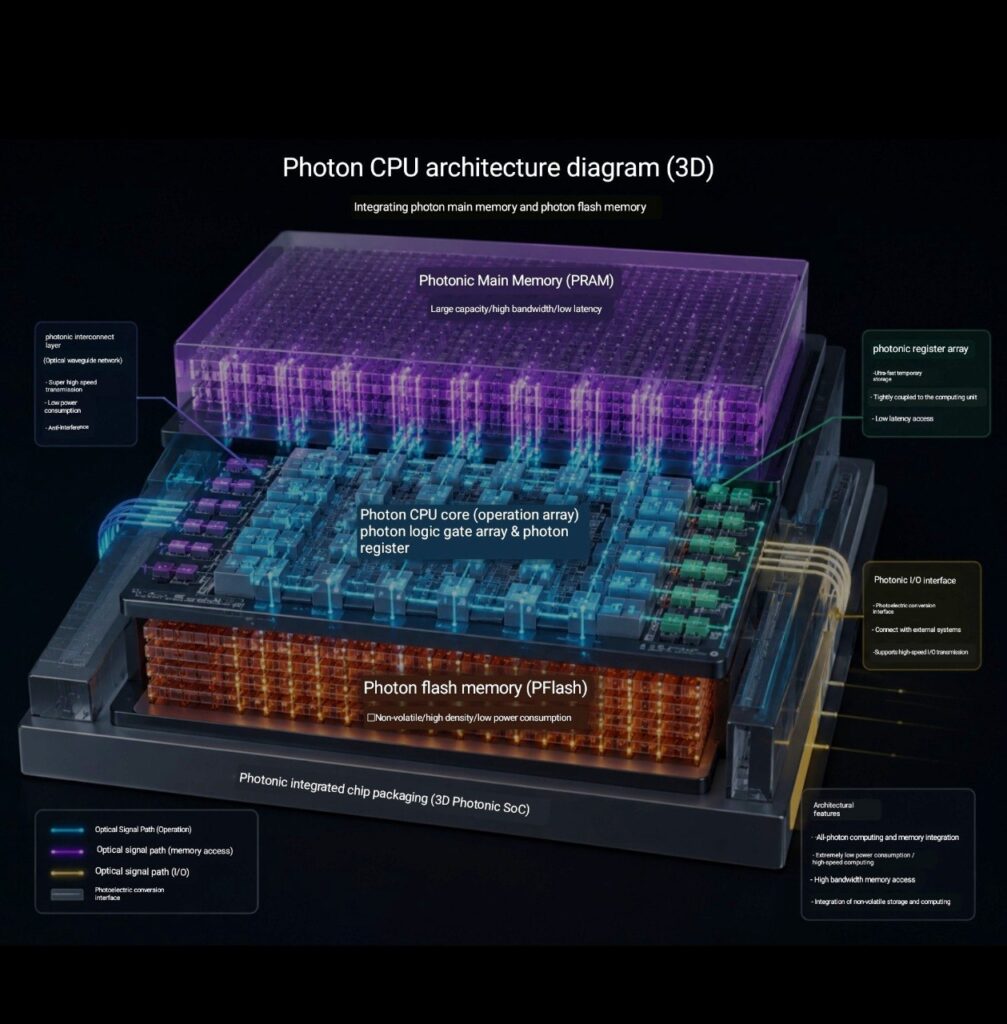
According to the company, its research focuses on integrating photonic processors, photonic memory concepts, optical interconnects, communication systems, and advanced packaging into a unified architecture designed to reduce latency, improve bandwidth efficiency, and optimize system-level performance.
Building an Optical Data Fabric
One of the largest engineering challenges facing AI infrastructure is communication.
Training large foundation models requires enormous volumes of information to travel continuously between GPUs, memory arrays, networking equipment, and storage clusters.
LongServing Technology is investigating optical communication pathways intended to create what it describes as an integrated photonic data fabric—a high-speed architecture in which optical technologies play a larger role in moving information throughout future computing systems.
According to the company, such research may contribute to future developments in AI clusters, cloud computing infrastructure, distributed processing environments, and optical networking technologies.
X-Photon: Materials Engineering for Integrated Photonics
Every computing architecture depends upon its underlying materials.
For conventional electronics, silicon has served this role for decades.
LongServing Technology’s research instead centers on X-Photon, a proprietary photonic material platform that the company says is being developed to support nanoscale optical structures.
According to LongServing Technology, X-Photon research includes investigations into optical pathways suitable for integrated photonic circuits, optical signal routing, and future photonic computing architectures.
The company believes advanced materials will become increasingly important as AI infrastructure evolves toward greater integration between computing, communications, and storage.

Rethinking Memory for AI Workloads
As AI models continue expanding in size, memory architecture has become one of the industry’s most important engineering challenges.
Processor performance alone is no longer sufficient.
The speed with which data moves between memory and computational resources increasingly determines overall system efficiency.
LongServing Technology is researching photonic memory concepts designed to complement future photonic computing systems.
According to the company, these technologies are intended to support high-bandwidth data movement while reducing repeated optical-electrical signal conversions that occur within many existing computing platforms.
The company views memory not as a supporting component, but as a central pillar of future AI infrastructure.
Architecting Intelligent Hardware
Rather than approaching hardware as individual chips, LongServing Technology describes its research as architectural engineering.
Its long-term roadmap includes investigations into:
- Integrated photonic processors
- Optical communication networks
- Photonic memory technologies
- AI acceleration architectures
- High-density optical storage
- Advanced packaging systems
- Optical interconnect fabrics
- Future intelligent edge computing platforms
According to the company, these technologies are intended to function together as components within a broader AI-native computing ecosystem.
Engineering for Sustainability
Artificial intelligence has also introduced new environmental challenges.
Large AI data centers consume substantial amounts of electricity while generating significant heat that must be managed through increasingly sophisticated cooling infrastructure.
LongServing Technology believes future computing platforms should prioritize energy efficiency alongside computational performance.
According to the company, its research into photonic technologies seeks to explore architectures that could contribute to lower energy consumption and improved thermal efficiency compared with conventional electronic approaches.
Sustainability has therefore become an integral design objective rather than an afterthought.
Innovation Beyond Artificial Intelligence
Although AI remains a major focus, LongServing Technology continues expanding research into additional scientific disciplines.
The company has introduced laboratory-grown Imperial Green jadeite through advanced materials engineering and is investigating natural plant-derived compounds with potential antiviral and anticancer applications.
According to LongServing Technology, preliminary laboratory studies have shown promising in vitro activity involving selected cancer cell lines. The company welcomes collaboration with hospitals, universities, biotechnology companies, and medical researchers interested in advancing future scientific investigations.
An Innovation Strategy Built on Interdisciplinary Research
Dr. Ko-Cheng Fang’s approach reflects a broader philosophy that tomorrow’s technologies will emerge through collaboration between multiple scientific disciplines rather than isolated engineering efforts.
Cybersecurity, advanced materials, photonics, artificial intelligence, biotechnology, manufacturing, and industrial design increasingly intersect within the company’s research roadmap.
This multidisciplinary strategy positions LongServing Technology to explore technologies that extend beyond individual products toward complete innovation ecosystems.
Preparing for the Next Generation of Global Technology
As LongServing Technology continues developing its research portfolio, it is also advancing its international business strategy through pre-IPO planning while seeking collaboration with experienced financial institutions, research organizations, industrial partners, and technology companies.
The company believes that future breakthroughs in AI infrastructure will depend not only on scientific discovery but also on strategic global collaboration capable of transforming laboratory research into scalable commercial technologies.

The Next Chapter of AI Infrastructure
Artificial intelligence is reshaping the technological landscape faster than any previous computing revolution.
Tomorrow’s competitive advantage may depend less on software alone and more on the underlying infrastructure capable of supporting intelligent systems at unprecedented scale.
Through research spanning photonic materials, optical architectures, cybersecurity, advanced manufacturing, biotechnology, and sustainable engineering, LongServing Technology is pursuing a long-term vision for integrated AI infrastructure.
Whether that vision ultimately defines future computing platforms will depend on continued research, engineering progress, and industry collaboration. Yet one thing is already clear: as artificial intelligence evolves, the architecture beneath it is becoming just as important as the intelligence itself.
